Wednesday, February 15, 2012

To My Old Master | A Letter From a Former Slave

To My Old Master | A Letter From a Former Slave:

Monday, 30 January 2012

To My Old Master


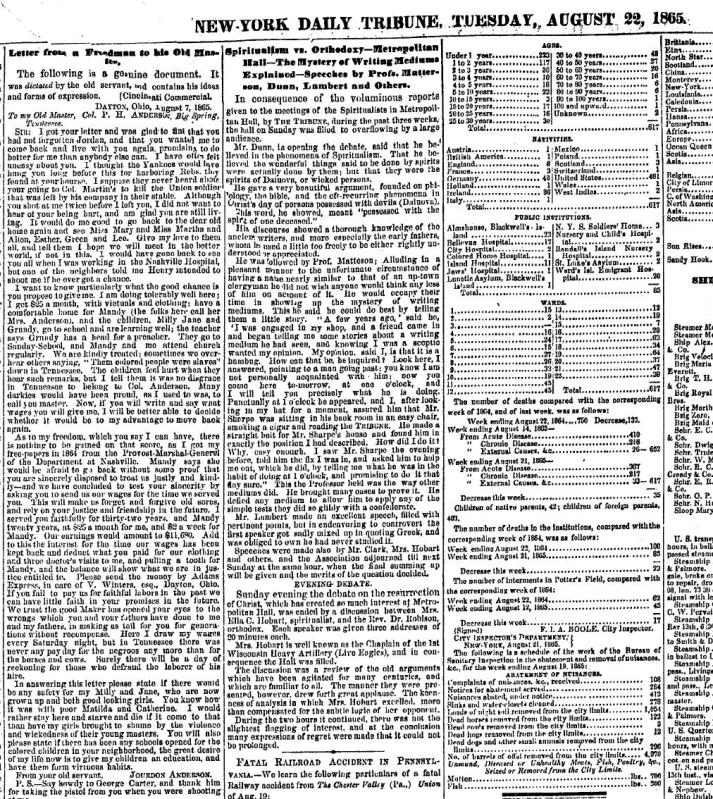
In August of 1865, a Colonel P.H. Anderson of Big Spring, Tennessee, wrote to his former slave, Jourdon Anderson, and requested that he come back to work on his farm. Jourdon — who, since being emancipated, had moved to Ohio, found paid work, and was now supporting his family — responded spectacularly by way of the letter seen below (a letter which, according tonewspapers at the time, he dictated).

Rather than quote the numerous highlights in this letter, I'll simply leave you to enjoy it. Do make sure you read to the end.

UPDATE: Head over to Kottke for a brief but lovely little update about the later years of Jourdon and family.

(Source: The Freedmen's Book; Image: A group of escaped slaves in Virginia in 1862, courtesy of the Library of Congress.)

Dayton, Ohio,

August 7, 1865

To My Old Master, Colonel P.H. Anderson, Big Spring, Tennessee

Sir: I got your letter, and was glad to find that you had not forgotten Jourdon, and that you wanted me to come back and live with you again, promising to do better for me than anybody else can. I have often felt uneasy about you. I thought the Yankees would have hung you long before this, for harboring Rebs they found at your house. I suppose they never heard about your going to Colonel Martin's to kill the Union soldier that was left by his company in their stable. Although you shot at me twice before I left you, I did not want to hear of your being hurt, and am glad you are still living. It would do me good to go back to the dear old home again, and see Miss Mary and Miss Martha and Allen, Esther, Green, and Lee. Give my love to them all, and tell them I hope we will meet in the better world, if not in this. I would have gone back to see you all when I was working in the Nashville Hospital, but one of the neighbors told me that Henry intended to shoot me if he ever got a chance.

I want to know particularly what the good chance is you propose to give me. I am doing tolerably well here. I get twenty-five dollars a month, with victuals and clothing; have a comfortable home for Mandy,—the folks call her Mrs. Anderson,—and the children—Milly, Jane, and Grundy—go to school and are learning well. The teacher says Grundy has a head for a preacher. They go to Sunday school, and Mandy and me attend church regularly. We are kindly treated. Sometimes we overhear others saying, "Them colored people were slaves" down in Tennessee. The children feel hurt when they hear such remarks; but I tell them it was no disgrace in Tennessee to belong to Colonel Anderson. Many darkeys would have been proud, as I used to be, to call you master. Now if you will write and say what wages you will give me, I will be better able to decide whether it would be to my advantage to move back again.

As to my freedom, which you say I can have, there is nothing to be gained on that score, as I got my free papers in 1864 from the Provost-Marshal-General of the Department of Nashville. Mandy says she would be afraid to go back without some proof that you were disposed to treat us justly and kindly; and we have concluded to test your sincerity by asking you to send us our wages for the time we served you. This will make us forget and forgive old scores, and rely on your justice and friendship in the future. I served you faithfully for thirty-two years, and Mandy twenty years. At twenty-five dollars a month for me, and two dollars a week for Mandy, our earnings would amount to eleven thousand six hundred and eighty dollars. Add to this the interest for the time our wages have been kept back, and deduct what you paid for our clothing, and three doctor's visits to me, and pulling a tooth for Mandy, and the balance will show what we are in justice entitled to. Please send the money by Adams's Express, in care of V. Winters, Esq., Dayton, Ohio. If you fail to pay us for faithful labors in the past, we can have little faith in your promises in the future. We trust the good Maker has opened your eyes to the wrongs which you and your fathers have done to me and my fathers, in making us toil for you for generations without recompense. Here I draw my wages every Saturday night; but in Tennessee there was never any pay-day for the negroes any more than for the horses and cows. Surely there will be a day of reckoning for those who defraud the laborer of his hire.

In answering this letter, please state if there would be any safety for my Milly and Jane, who are now grown up, and both good-looking girls. You know how it was with poor Matilda and Catherine. I would rather stay here and starve—and die, if it come to that—than have my girls brought to shame by the violence and wickedness of their young masters. You will also please state if there has been any schools opened for the colored children in your neighborhood. The great desire of my life now is to give my children an education, and have them form virtuous habits.

Say howdy to George Carter, and thank him for taking the pistol from you when you were shooting at me.

From your old servant,

Jourdon Anderson.


'via Blog this'

Facebook IPO: Wall Street Sells Another Illusion

Facebook IPO: Wall Street Sells Another Illusion:

Prime IPO beneficiary Mark Zuckerberg delivers the keynote address at the Facebook f8 conference in San Francisco, 09/22/11. (photo: Getty Images)


Facebook IPO: Wall Street Sells Another Illusion

By DJ Pangburn, Death and Taxes

01 February 12

ne of the rather little known stories of World War II, situated within the even lesser known spy campaigns in North and South America, involves J. Edgar Hoover and spymaster William Stephenson, the man who served as one of the real life analogues of James Bond. Stephenson, as chief of the British Security Coordination (BSC) in New York City, was tasked with ensuring that if the UK was overrun by the Nazis, that the Crown could effectively run a resistance campaign from the American shores.

Stephenson's organization ran extensive media and propaganda efforts within the U.S., Canada and South America in attempt to convince the Western hemisphere that the fight against Hitler & Co was of prime importance. Naturally, the British spymaster had to interface with FBI Chief Hoover, who was not at all pleased that Stephenson was operating on domestic soil.

To mollify Hoover, Stephenson brought Hoover to Camp X near Lake Ontario, a base of operations where the OSS (forerunner of the CIA), Britian's covert resistance organization Special Operations Executive (SEO), and the FBI were trained to engage in paramilitary operations behind enemy lines. When Stephenson and Hoover arrived at Camp X, Hoover was told to look out across Lake Ontario, where he saw what he believed were several warships. In reality, those warships were created by a magician named Jasper Maskelyne using multiple mirrors and a toy battleship. Hoover didn't see what was actually there, but what his mind expected to see.

Like Maskelyne and a legion of other magicians, Wall Street very often excels at the art of illusion, especially when it comes to the IPO (Initial Public Offering)—and so it shall be with Facebook.

We have been told by various inside sources and financial experts (since Facebook is still a private company) that the coming Facebook IPO will supposedly value the company somewhere in the vicinity of $75 billion to $100 billion. All of this, of course, for a company that connects people on a very superficial level and profits on the collection and sale of user data.

Perhaps Facebook is worth at least as much as its 2011 revenues suggest, which were $4.27 billion, a figure which was double 2010′s revenues of $2 billion. And perhaps there is room for growth within that revenue stream as Facebook rolls out its Timeline interface and becomes more and more efficient at invasively gathering user data.

However, does anyone outside of the dream factories of Wall Street and Silicon Valley seriously believe that Facebook should be valued at $75 billion on the low end and $100 billion on the high end? As I noted in early 2011, all of this smells exactly like another tech bubble to replace the burst housing bubble. TheGreat Facebook Bubble‘s inflation is absurd. Wall Street banks and investors, as well as Facebook's numerous stockholders—many of whom are looking to cash out their stocks with the IPO—stand to benefit if they can create the illusion that Facebook is actually worth $100 billion.

The goal is to spread the belief in the illusion such that the valuation reaches its apogee, then falls over time (as all stocks do), by which point the wise investors will have already laughed all the way to the bank. As initial investors that is their right, of course, but it doesn't mean they didn't create and sell an illusion in the process.

Facebook CEO Mark Zuckerberg has stated over and over again that he wants control of the company in the long-term, and if that holds true, he will have to ride the IPO's high to a more sane stock valuation in the future. Zuckerberg has also claimed that money matters little to him; that may be so, but employees and investors who bought in early (like Goldman Sachs and even the Winklevii) want to get paid with the IPO. Thus Zuckerberg might not benefit immensely from the sale of an illusion (since he won't be dumping all his stock), but plenty of investors will.

Whatever happens with the IPO, it will be interesting to watch the coming magic show and witness theever-evolving data mining methods devised by Facebook to please their new investors.

Monday, February 6, 2012

The Citizens United catastrophe - The Washington Post

The Citizens United catastrophe - The Washington Post:

By , Published: February 5

We have seen the world created by the Supreme Court’s Citizens United decision, and it doesn’t work. Oh, yes, it works nicely for the wealthiest and most powerful people in the country, especially if they want to shroud their efforts to influence politics behind shell corporations. It just doesn’t happen to work if you think we are a democracy and not a plutocracy.

Two years ago, Citizens United tore down a century’s worth of law aimed at reducing the amount of corruption in our electoral system. It will go down as one of the most naive decisions ever rendered by the court.

E.J. Dionne Jr.

Writes about politics in a twice-a-week column and on the PostPartisan blog.

Archive

Gallery

More Election 2012

More Election 2012

A collection of Ann Telnaes animations on the presidential race.

The strongest case against judicial activism — against “legislating from the bench,” as former President George W. Bush liked to say — is that judges are not accountable for the new systems they put in place, whether by accident or design.

The Citizens United justices were not required to think through the practical consequences of sweeping aside decades of work by legislators, going back to the passage of the landmark Tillman Act in 1907, who sought to prevent untoward influence-peddling and indirect bribery.

If ever a court majority legislated from the bench (with Bush’s own appointees leading the way), it was the bunch that voted forCitizens United. Did a single justice in the majority even imagine a world of super PACs and phony corporations set up for the sole purpose of disguising a donor’s identity? Did they think that a presidential candidacy might be kept alive largely through the generosity of a Las Vegas gambling magnate with important financial interests in China? Did they consider that the democratizing gains made in the last presidential campaign through the rise ofsmall online contributors might be wiped out by the brute force of millionaires and billionaires determined to have their way?

“The appearance of influence or access, furthermore, will not cause the electorate to lose faith in our democracy.” Those were Justice Anthony Kennedy’s words in his majority opinion. How did he know that? Did he consult the electorate? Did he think this would be true just because he said it?

Justice John Paul Stevens’ observation in his dissent reads far better than Kennedy’s in light of subsequent events. “A democracy cannot function effectively,” he wrote, “when its constituent members believe laws are being bought and sold.”

But ascribing an outrageous decision to naivetéis actually the most sympathetic way of looking at what the court did in Citizens United. A more troubling interpretation is that a conservative majority knew exactly what it was doing: that it set out to remake our political system by fiat in order to strengthen the hand of corporations and the wealthy. Seen this way, Citizens United was an attempt by five justices to push future electoral outcomes in a direction that would entrench their approach to governance.

In fact, this decision should be seen as part of a larger initiative by moneyed conservatives to rig the electoral system against their opponents. How else to explain conservative legislation in state after state to obstruct access to the ballot by lower-income voters — particularly members of minority groups — through voter identification laws, shortened voting periods and restrictions on voter registration campaigns?

Conservatives are strengthening the hand of the rich at one end of the system and weakening the voting power of the poor at the other. As veteran journalist Elizabeth Drew noted in an important New York Review of Books article, “little attention is being paid to the fact that our system of electing a president is under siege.”

Those who doubt that Citizens United (combined with a comatose Federal Election Commission) has created a new political world with broader openings for corruption should consult reports last week by Nicholas Confessore and Michael Luo in the New York Times and by T.W. Farnam in The Washington Post. Both accounts show how American politics has become a bazaar for the very wealthy and for increasingly aggressive corporations. We might consider having candidates wear corporate logos. This would be more honest than pretending that tens of millions in cash will have no impact on how we will be governed.

In the short run, Congress should do all it can within the limits of Citizens United to contain the damage it is causing. In the long run, we have to hope that a future Supreme Court will overturn this monstrosity, remembering that the first words of our Constitution are “We the People,” not “We the Rich.”

ejdionne@washpost.com

Sunday, January 29, 2012

Time to Break Up Zombie Bank of America? | | AlterNet

Time to Break Up Zombie Bank of America? | | AlterNet

comments_image 14 COMMENTS

Time to Break Up Zombie Bank of America?

The B of A death watch continues as a new petition calls for federal regulators to dismantle the big bank before it implodes.
LIKE THIS ARTICLE ?
Join our mailing list:

Sign up to stay up to date on the latest headlines via email.

Does Bank of America pose a “grave threat” to America?

That's what Public Citizen is arguing in a new petition to the Federal Reserve Board of Governors and the Financial Stability Oversight Council, calling for the regulators to step in and break up the nation's second-largest bank before it collapses and kicks off another financial meltdown.

Under Section 121 of the Dodd-Frank Wall Street Reform and Consumer Protection Act, the government has the power to force a financial institution that poses such a systemic threat to divest assets, limit activities, or otherwise down-size so it's not “too big to fail.” According to Public Citizen's David Arkush, even though many of the big banks became even larger and more threatening after the financial crisis in 2007 and 2008, “Bank of America looks like it is the most systemically dangerous of the large banks and is at the greatest risk of actually failing.”

In a separate letter to Treasury Secretary Tim Geithner, Federal Reserve Chairman Ben Bernanke, and Acting FDIC Chairman Martin Gruenberg, several economists and activist groups including Marshall Auerback, Dean Baker, William K. Black, National People's Action, and New Bottom Line called on the regulators to look into Bank of America as well as other large banks. They wrote:

Recently many questions have been posed regarding the financial condition of Bank of America and several other large and complex financial institutions. If any of these institutions were to deteriorate, it could threaten the U.S. financial system. We urge you to investigate their stability, to analyze potential outcomes in the event of a failure, and to take any actions necessary to ensure systemic stability. The Dodd-Frank Wall Street Reform and Consumer Protection Act charges you with ensuring the stability of the U.S. financial system, and provides you with a broad range of tools to do so.

Bank of America has been in trouble for a while; as I reported in August, lawsuits against the big bank stemming from its purchase of Countrywide, one of the worst culprits in the subprime lending bubble, were the primary source of its financial woes, but hardly the only one. Its stock price plummeted 50 percent in 2011, angry depositors rebelled against a proposed $5 fee on their accounts, and JPMorgan Chase surpassed it as the largest financial institution in the country. It still holds assets, Public Citizen noted in its press release, equal to roughly one-seventh of the entire gross domestic product of the United States.

“Ordinarily what you would expect to say if we have a company that is making bad judgment, buying up Merrill Lynch, buying up Countrywide, making a lot of other bad judgments, you'd go 'well the market will put them out of business',” said Dean Baker of the Center for Economic and Policy Research, on a conference call held by Public Citizen. “That doesn't happen with Bank of America because they're basically operating with too-big-to-fail insurance.”

An attempt in 2010 by Senators Sherrod Brown (D-OH) and Ted Kaufman (D-DE) to insert a provision into the Dodd-Frank reform legislation that would have limited the size of the big banks failed in the Senate. As a result, the only real protection it offers from another systemic crisis touched off by the collapse of another major bank is the ability for regulators to step in if that bank appears to be a “grave threat”. This requires regulators to be aware of the shaky standing of a big bank before it goes from unstable to full-on implosion—because by then, it's probably too late to stop the bleeding.

“If Bank of America were to fail, any attempt at the orderly liquidation process in the Wall Street Reform law might not work, basically because the institution is too large, too complex, and because it has branches in too many foreign countries,” Arkush argued.

Lawrence Baxter, a former Wachovia Bank executive and a professor at Duke Law School, said on the conference call, “This petition is very important as a step in testing whether the machinery provided by the Dodd-Frank act for preventing another meltdown has any substance.”

That's important because in many cases, regulators and the Obama administration have moved to prop up the big banks rather than dismantle them—not only with the defeat of the Brown-Kaufman proposal but other moves by the Fed to help the banks stay afloat any way possible.

Arthur Willmarth, a George Washington University law professor also on Public Citizen's conference call, used as an example a recent move by Bank of America to shift potentially toxic derivatives from one of its subsidiaries to another. Backed up by the Fed, the bank moved the risky financial instruments from its investment banking arm, Merrill Lynch, to its deposit banking arm—which is insured by the taxpayers through the FDIC. That means that if the assets go bad, like so many of the “toxic assets” during the earlier financial crisis did, taxpayers are on the hook for another big bailout. As William K. Black wrote, this move was essentially “transforming (ala Ireland) a private debt into a public debt.”

Economists love to talk about “moral hazard”--the idea that someone will take more risks if they know they are less likely to face the consequences of those risks. But as Salon contributor David Sirota wrote back in 2009, “[A]s evidenced by trillions of dollars in public loans, guarantees and subsidies given to speculators to cover their massive losses, leaders in both political parties have no interest in preventing financial moral hazard — despite stern press releases insisting the contrary. By rewarding rather than punishing Wall Street for losing irresponsibly risky bets and by holding out the promise of similar bailout rewards in the future, politicians have incentivized even more irresponsible risk-taking for years to come.”

As Obama took the stage for his State of the Union speech this week, it was clear that the financial crisis was still on his mind as well as the minds of people around the country, still dealing with the fallout from foreclosures and the disappearance of their wealth. If, as David Dayen at FireDogLake noted, the Administration and regulators want to prove that they're on the side of the people and not the banks, the Public Citizen petition provides them an excellent opportunity to do just that.

Of course, Obama's still planning on accepting his party's nomination for reelection at Charlotte, North Carolina's Bank of America stadium, and he's still counting on cash from the big banks in order to propel him to that reelection. The following year will more likely see him trying to strike a balance between appearing tough on the banks and not actually driving them completely into the arms of his GOP rival, whomever that may be.

Still, the good news, William K. Black argued, is that if regulators choose to act on Public Citizen's petition, “We can deal with [the big banks], we can shrink them to a size they no longer pose a systemic risk, and in doing so we will actually make them more efficient, not less efficient.”

Sarah Jaffe is an associate editor at AlterNet, a rabblerouser and frequent Twitterer. You can follow her at @seasonothebitch.

Selling the 'Supply-Side' Myth

Selling the 'Supply-Side' Myth
By Robert Parry

Rep. Newt Gingrich, R-Ga., laughs at a joke told by President Ronald Reagan in Atlanta, Jan. 26, 1984. (photo: Joe Holloway, Jr./AP)


Selling the 'Supply-Side' Myth

By Robert Parry, Consortium News

28 January 12

espite Newt Gingrich's claim that "supply-side" economic theories have "worked," the truth is that America's three-decade experiment with low tax rates on the rich, lax regulation of corporations and "free trade" has been a catastrophic failure, creating massive federal debt, devastating the middle class and off-shoring millions of American jobs.

It has "worked" almost exclusively for the very rich, yet the former House speaker and the three other Republican presidential hopefuls are urging the country to double-down on this losing gamble, often to the cheers of their audiences — like one Florida woman who said she had lost her job and medical insurance but still applauded the idea of more "free-market" solutions.

Gingrich even boasts of his role in pioneering these theories of massive tax cuts favoring the rich, combined with sharp reductions in the role of government. That approach, once famously mocked by George H.W. Bush as "voodoo economics," was supposed to spur businesses to expand production (the "supply side"), thus creating jobs and boosting revenues from all the commercial activity.

"I worked with Ronald Reagan to develop supply-side economics in the late '70s, along with Jack Kemp and Art Laffer and Jude Wanniski and others," Gingrich declared at a recent town hall event. "We ended up passing it into law in '81. At the time it was very bold. People called it 'voodoo economics.' It had one great virtue: it worked."

But that is not what the historical record really shows.

In 1980, I was working as an Associated Press correspondent covering budget and economic issues on Capitol Hill - and at the time, the "supply-siders" had two key arguments in their favor: first, the economy had stagnated in the 1970s largely due to oil price shocks, inflation and an aging industrial base.

Their second key advantage was that nobody could say for sure what the results of the "supply-side" experiment would be. There was little empirical data to assess how radical tax cuts would play out in the modern economy. One could make common-sense judgments, as George H.W. Bush had done with his "voodoo" remark, but you couldn't see the future.

No More Mystery

Now, however, with three decades of experience with the experiment, the fallacies of "supply-side" economics are no longer a mystery. For instance, a major obstacle to today's economic recovery has been the absence of "demand-side" consumers, not the availability of money to build more productive capacity.

And the reason that there are fewer consumers is that the Great American Middle Class, which the federal government helped build and nourish from the New Deal through the GI Bill to investments in infrastructure and technology in the Sixties and Seventies, has been savaged over the past three decades.

Though many Americans were able to cover up for their declining economic prospects with excessive borrowing for a while, the Wall Street crash of 2008 exposed the hollowing out of the middle class. So today, businesses are sitting on vast sums of cash - some estimates put the amount at about $2 trillion.

And the reasons for this dilemma are now well-known: first, when companies have expanded in recent years, the modern factories have relied on robotics with few humans required; second, the companies put many manufacturing sites offshore so they can exploit cheap labor; and third, the shrinking middle class has meant fewer customers, leaving corporations little motivation to build more factories.

For Americans, this has represented a downward spiral with no end in sight. American workers, whether blue- or white-collar, know that computers and other technological advancements have made many of their old jobs obsolete. And modern communications have allowed even expert service jobs, like computer tech advice, to go to places like India.

While painful to millions of Americans who find their talents treated as surplus, these developments do not by themselves have to be negative. After all, humans have dreamed for centuries about technology freeing them from the grind of tedious work and freeing up society to invest in a higher quality of life, for today's citizens and for posterity.

The problem is that the only practical way for a democratic society to achieve that goal is to have a vibrant government using the tax structure to divert a significant amount of the super-profits from the rich into the public coffers for investments in everything from infrastructure to education to arts and sciences, including research and development for future generations, even possibly Gingrich's "big idea" of a colony on the moon.

In fact, that kind of virtuous cycle was the experience of the United States from the 1930s through the 1970s, with the federal government taxing the top tranches of wealth at up to 90 percent and using those funds to build major electrification projects like the Hoover Dam and the Tennessee Valley Authority, to educate World War II veterans through the GI Bill, to connect the nation through the Interstate Highway system, to launch the Space Program, and to create today's Internet.

Out of those efforts emerged robust economic growth as private corporations took advantage of the nation's modern infrastructure and the technological advancements. Millions of good-paying jobs were created for the world's best-trained work force, giving rise to the Great American Middle Class. The obvious answer was to keep this up, with the government investing in new productive areas, like renewable energy.

Demonizing 'Guv-mint'

Instead, facing economic headwinds in the 1970s, caused in part by rising energy costs, Americans grew anxious about their futures, making them ripe for a new right-wing propaganda campaign demonizing "guv-mint" and telling white men, in particular, that the "free market" was their friend.

Blessed with a talented pitch man named Ronald Reagan, "supply-side" became the new product to sell. After taking office, Reagan pressed for a sharp reduction in the marginal tax rates, slashing the top rates for the wealthy from around 70 percent to 28 percent. Along with the tax cuts, Reagan also initiated an aggressive military buildup.

The results were devastating to the U.S. fiscal position. The federal debt soared, quadrupling during the 12 years of Reagan and Bush Sr. As a percentage of the gross domestic product, federal debt was actually declining in the 1970s, dropping to 26 percent of GDP, before exploding under Reagan, rising to 41 percent by the end of the 1980s. The shared wealth of the country also diverged, with the rich claiming a bigger and bigger piece of the national economic pie.

The nation's debt crisis only began to subside after tax increases were enacted under President George H.W. Bush and President Bill Clinton, with Clinton's tax hike pushing the top marginal rate back up to 39.6 percent. At the time, Gingrich warned that the Clinton tax hike would lead to an economic catastrophe.

The actual result was a booming economy, spurred strongly by the federal government's new "information super-highway," the Internet. The Clinton years also saw low unemployment and a balanced budget by the late 1990s. The debt-to-GDP measure declined from about 43 percent to 33 percent and was on course toward zero within a decade.

Ironically Gingrich also claims credit for that because - as House speaker - he worked with Clinton on some cost-cutting measures, but Clinton credits the 1993 tax increase, which passed without a single Republican vote, as the key factor in the budget turnaround.

After George W. Bush claimed the White House in 2001, "supply-side" dogma was back in vogue. Bush pushed through more tax cuts mostly for the rich, reducing the top marginal rate to 35 percent and creating an even bigger tax break for investors, cutting the capital gains rate to 15 percent. Combined with Bush's two wars and other policies, the surplus soon disappeared and was replaced by another yawning deficit.

Even as most Americans struggled to hold a job and pay their bills, America's super-rich lived a life of unparalleled luxury. With this concentration of money also had come a concentration of power, as right-wing operatives were hired to build a sophisticated media apparatus and think tanks to push - often with populist rhetoric - the policies that were dividing the country along the lines of a pampered one percent and a pressured 99 percent.

Many Americans, especially white men, heard their personal grievances echoed in the angry voices of Rush Limbaugh, Sean Hannity, Michael Savage and Glenn Beck - all well-compensated propagandists for "the one percent."

Lesson Unlearned

Now, looking back over the economic and fiscal history of the past three decades, you might think that few Americans would be fooled again by this sucker bet on "supply-side." But the Tea Partiers and many rank-and-file Republicans seem ready to put what's left of their money back down on the gambling table.

All four remaining Republican hopefuls - Mitt Romney, Rick Santorum, Ron Paul and Gingrich - have proposed lower tax rates especially on the rich with the same enduring but fanciful faith in "supply-side" economics.

Gingrich has gone so far as to advocate eliminating the capital gains tax entirely. It's already down to 15 percent, meaning that many super-rich, from financier Warren Buffett to Mitt Romney, can live off their investments and pay a lower tax rate than what many middle-class Americans pay on their wages and salaries. In a recent Florida debate, Romney noted he would pay virtually no federal income tax under Gingrich's plan.

The Republicans seem to be counting on the parallel propaganda campaign of demonizing "guv-mint." They're pinning their hopes on an ill-informed electorate (especially white men) siding with "the one percent" over their own working- and middle-class interests.

The GOP hopes also may hinge significantly on how determined some whites are to get the country's first black president out of the White House. Historically, demagogic U.S. politicians have had great success in exploiting racial resentments, although these days often with coded language like Gingrich calling Barack Obama "the food-stamp president."

The Right also has worked diligently to create false narratives to convince many Americans that their hatred of a strong federal government links them to the Founders. Many Tea Partiers have bought into the historical lie that the Founders wrote the Constitution to limit the power of the federal government and to promote "states' rights" - the near opposite of what the framers actually were doing.

Led by Virginians Gen. George Washington and James Madison, the Constitutional Convention in 1787 threw out the Articles of Confederation, which had made the states supreme and the federal government a supplicant.

The Constitution reversed that situation, eliminating state "independence" and bestowing national sovereignty onto the federal Republic representing "we the people of the United States." Contrary to the Tea Party's false narrative, the Constitution represented the single biggest assertion of federal power in U.S. history.

When the Tea Partiers dress up in Revolutionary War costumes, they apparently don't know that their notion of a weak central government and state "sovereignty" was anathema to the key framers of the Constitution, especially to Washington who had watched his soldiers suffer under the ineffectual Articles of Confederation.

And, when the Tea Partiers wave their "Don't Tread on Me" flags of a coiled snake, they don't seem to know that the warning was directed at the British Empire and that the banner aimed at fellow Americans was Benjamin Franklin's image of a snake severed into various pieces representing the colonies/states with the admonishment "Join, or Die."

Nevertheless, false narratives and false arguments can be as effective as real ones to a thoroughly misinformed population. Thus, many middle- and working-class Americans still cheer when Newt Gingrich references Ronald Reagan and his "supply-side" economics.

But the failure of Reagan's economic strategy should be obvious to anyone who is not fully deluded by right-wing propaganda. Not only has the national debt skyrocketed over the past three decades, but whatever economic benefits that have been produced have gone overwhelmingly to the wealthy - while the nation as a whole has suffered.


For more on related topics, see Robert Parry's "Lost History," "Secrecy & Privilege" and "Neck Deep," now available in a three-book set for the discount price of only $29. For details, click here.

Robert Parry broke many of the Iran-Contra stories in the 1980s for the Associated Press and Newsweek. His latest book, "Neck Deep: The Disastrous Presidency of George W. Bush," was written with two of his sons, Sam and Nat, and can be ordered at neckdeepbook.com. His two previous books, "Secrecy & Privilege: The Rise of the Bush Dynasty from Watergate to Iraq" and "Lost History: Contras, Cocaine, the Press & 'Project Truth'" are also available there.