Monday, February 20, 2012

Bruce Springsteen's Angry Patriotism

Bruce Springsteen's Angry Patriotism

Bruce Springsteen has released a new album that he describes as rooted in an 'angry patriotism.' (photo: Columbia Records)


Bruce Springsteen's Angry Patriotism

By Fiachra Gibbons, Guardian UK

19 February 12

The Boss explains why there is a critical, questioning and angry patriotism at the heart of his new album, Wrecking Ball.

t a Paris press conference on Thursday night, Bruce Springsteen was asked whether he was advocating an armed uprising in America. He laughed at the idea, but that the question was even posed at all gives you some idea of the fury of his new album Wrecking Ball.

Indeed, it is as angry a cry from the belly of a wounded America as has been heard since the dustbowl and Woody Guthrie, a thundering blow of New Jersey pig iron down on the heads of Wall Street and all who have sold his country down the swanny. Springsteen has gone to the great American canon for ammunition, borrowing from folk, civil war anthems, Irish rebel songs and gospel. The result is a howl of pain and disbelief as visceral as anything he has ever produced, that segues into a search for redemption: "Hold tight to your anger / And don't fall to your fears ... Bring on your wrecking ball."

"I have spent my life judging the distance between American reality and the American dream," Springsteen told the conference, where the album was aired for the first time. It was written, he claimed, not just out of fury but out of patriotism, a patriotism traduced.

"What was done to our country was wrong and unpatriotic and un-American and nobody has been held to account," he later told the Guardian. "There is a real patriotism underneath the best of my music but it is a critical, questioning and often angry patriotism."


The tone is set from the start with the big, bombastic We Take Care of Our Own - a Born in the USA for our times - where the most sacred shibboleth of Ordinary Joe America is sung with mocking irony through clenched teeth by a heart that still wants it to be true. "From the shotgun shack to the Superdome/ There ain't no help, the cavalry stayed home." It is a typical Springsteen appeal to a common decency beyond the civil war he sees sapping America.

Like Born in the USA, which got pressed into service as the anthem of the first Gulf war, he's aware it has the potential to be hijacked by the angry right. But Springsteen says that to anyone who cares to listen to the lyrics, the message is clear.

"A big promise has been broken. You can't have a United States if you are telling some folks that they can't get on the train. There is a cracking point where a society collapses. You can't have a civilisation where something is factionalised like this."

Springsteen plunges into darker, richer musical landscapes in a sequence of breath-taking protest songs - Easy Money, Shackled and Drawn, Jack of All Trades, the scarily bellicose Death to My Hometown and This Depression with Tom Morello of Rage Against the Machine - before the album turns on Wrecking Ball in search of some spiritual path out of the mess the US is in.

But it is also an ode to hard work, to the dignity it brings, and the blue-collar values he claims made America:

"Freedom son's a dirty shirt
The sun on my face and my shovel in the dirt
A shovel in the dirt keeps the devil gone
I woke up this morning shackled and drawn"

Asked where the fury of this lyric had come from, he talks movingly of his father who had been "emasculated by losing his job" in the 70s and never recovered from the damage to his pride. "Unemployment is a really devastating thing. I know the damage it does to families. Growing up in that house there were things you couldn't say. It was a minefield. My mother was the breadwinner. She was steadfast and relentless and I took that from her.

"Pessimism and optimism are slammed up against each other in my records, the tension between them is where it's all at, it's what lights the fire."

Hope is there. But it is a tempered hope. Land of Hope and Dreams is a plea for America's newest immigrants, those risking their lives to ride the trains up from central America. "This train ... carries saints and sinners ... losers and winners ... whores and gamblers ... Dreams will not be thwarted ... Faith will be rewarded."

Springsteen, 62, says he is not afraid of how the album will be received in election-year America: "The temper has changed. And people on the streets did it. Occupy Wall Street changed the national conversation - the Tea Party had set it for a while. The first three years of Obama were under them.

"Previous to Occupy Wall Street, there was no push back at all saying this was outrageous - a basic theft that struck at the heart of what America was about, a complete disregard for the American sense of history and community ... In Easy Money the guy is going out to kill and rob, just like the robbery spree that has occurred at the top of the pyramid - he's imitating the guys on Wall Street. An enormous fault line cracked the American system right open whose repercussion we are only starting to be feel.

"Nobody had talked about income inequality in America for decades - apart from John Edwards - but no one was listening. But now you have Newt Gingrich talking about 'vulture capitalism' - Newt Gingrich! - that would not have happened without Occupy Wall Street."


Having previously backed Obama, Springsteen says he would prefer to stay on the sidelines this time. "I don't write for one side of the street ... But the Bush years were so horrific you could not just sit around. It was such a blatant disaster. I campaigned for Kerry and Obama, and I am glad I did. But normally I would prefer to stay on the sidelines. The artist is supposed to be the canary in the cage."

Obama hasn't done bad, Springsteen says. "He kept General Motors alive, he got through healthcare - though not the public system I would have wanted - he killed Osama Bin Laden, and he brought sanity to the top level of government. But big business still has too much say in government and there has not been as many middle- or working-class voices in the administration as I expected. I thought Guantanamo would have been closed but now, but he got us out of Iraq and I guess we will soon be out of Afghanistan."

The album is the last on which Clarence Clemons, the legendary saxophonist from the E Street Band, played on before he died last year. "When the sax comes up on Land of Hope and Dreams," Springsteen says, "it's a lovely moment for me."

• Wrecking Ball is released on 5 March via Columbia.

Friday, February 17, 2012

How Fares the Dream? - By PAUL KRUGMAN

How Fares the Dream? - NYTimes.com:
OP-ED COLUMNIST

How Fares the Dream?

“I have a dream,” declared Martin Luther King, in a speech that has lost none of its power to inspire. And some of that dream has come true. When King spoke in the summer of 1963, America was a nation that denied basic rights to millions of its citizens, simply because their skin was the wrong color. Today racism is no longer embedded in law. And while it has by no means been banished from the hearts of men, its grip is far weaker than once it was.

Fred R. Conrad/The New York Times

Paul Krugman

Related

Readers’ Comments

Readers shared their thoughts on this article.

To say the obvious: to look at a photoof President Obama with his cabinet is to see a degree of racial openness — and openness to women, too — that would have seemed almost inconceivable in 1963. When we observe Martin Luther King’s Birthday, we have something very real to celebrate: the civil rights movement was one of America’s finest hours, and it made us a nation truer to its own ideals.

Yet if King could see America now, I believe that he would be disappointed, and feel that his work was nowhere near done. He dreamed of a nation in which his children “will not be judged by the color of their skin but by the content of their character.” But what we actually became is a nation that judges people not by the color of their skin — or at least not as much as in the past — but by the size of their paychecks. And in America, more than in most other wealthy nations, the size of your paycheck is strongly correlated with the size of your father’s paycheck.

Goodbye Jim Crow, hello class system.

Economic inequality isn’t inherently a racial issue, and rising inequality would be disturbing even if there weren’t a racial dimension. But American society being what it is, there are racial implications to the way our incomes have been pulling apart. And in any case, King — who was campaigning for higher wages when he was assassinated — would surely have considered soaring inequality an evil to be opposed.

So, about that racial dimension: In the 1960s it was widely assumed that ending overt discrimination would improve the economic as well as legal status of minority groups. And at first this seemed to be happening. Over the course of the 1960s and 1970s substantial numbers of black families moved into the middle class, and even into the upper middle class; the percentage of black households in the top 20 percent of the income distribution nearly doubled.

But around 1980 the relative economic position of blacks in America stopped improving. Why? An important part of the answer, surely, is that circa 1980 income disparities in the United States began to widen dramatically, turning us into a society more unequal than at any time since the 1920s.

Think of the income distribution as a ladder, with different people on different rungs. Starting around 1980, the rungs began moving ever farther apart, adversely affecting black economic progress in two ways. First, because many blacks were still on the lower rungs, they were left behind as income at the top of the ladder soared while income near the bottom stagnated. Second, as the rungs moved farther apart, the ladder became harder to climb.

The Times recently reported on a well-established finding that still surprises many Americans when they hear about it: although we still see ourselves as the land of opportunity, we actually have less intergenerational economic mobility than other advanced nations. That is, the chances that someone born into a low-income family will end up with high income, or vice versa, are significantly lower here than in Canada or Europe.

And there’s every reason to believe that our low economic mobility has a lot to do with our high level of income inequality.

Last week Alan Krueger, chairman of the president’s Council of Economic Advisers, gave an important speech about income inequality, presenting a relationship he dubbed the “Great Gatsby Curve.” Highly unequal countries, he showed, have low mobility: the more unequal a society is, the greater the extent to which an individual’s economic status is determined by his or her parents’ status. And as Mr. Krueger pointed out, this relationship suggests that America in the year 2035 will have even less mobility than it has now, that it will be a place in which the economic prospects of children largely reflect the class into which they were born.

That is not a development we should meekly accept.

Mitt Romney says that we should discuss income inequality, if at all, only in “quiet rooms.” There was a time when people said the same thing about racial inequality. Luckily, however, there were people like Martin Luther King who refused to stay quiet. And we should follow their example today. For the fact is that rising inequality threatens to make America a different and worse place — and we need to reverse that trend to preserve both our values and our dreams.


'via Blog this'

Wednesday, February 15, 2012

To My Old Master | A Letter From a Former Slave

To My Old Master | A Letter From a Former Slave:

Monday, 30 January 2012

To My Old Master


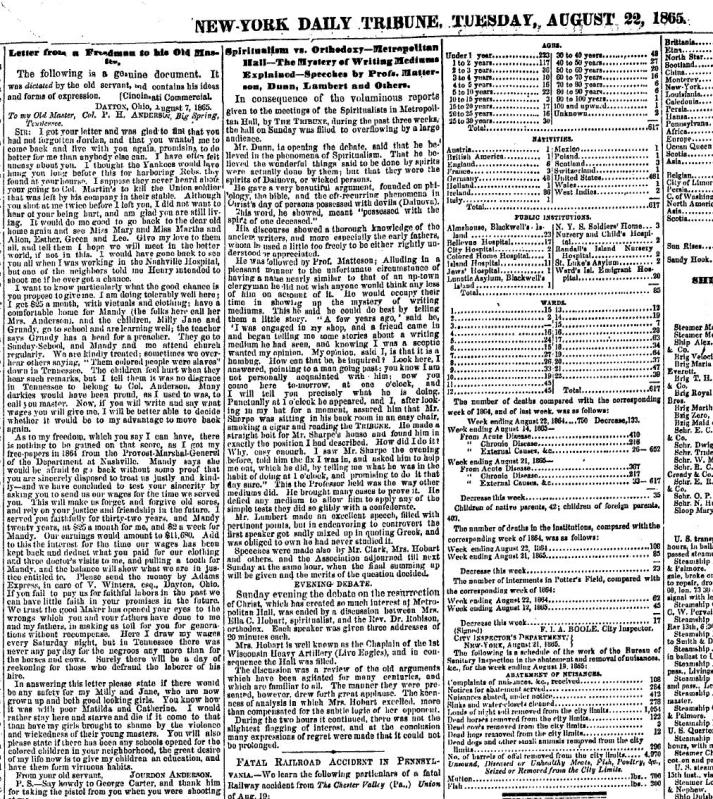
In August of 1865, a Colonel P.H. Anderson of Big Spring, Tennessee, wrote to his former slave, Jourdon Anderson, and requested that he come back to work on his farm. Jourdon — who, since being emancipated, had moved to Ohio, found paid work, and was now supporting his family — responded spectacularly by way of the letter seen below (a letter which, according tonewspapers at the time, he dictated).

Rather than quote the numerous highlights in this letter, I'll simply leave you to enjoy it. Do make sure you read to the end.

UPDATE: Head over to Kottke for a brief but lovely little update about the later years of Jourdon and family.

(Source: The Freedmen's Book; Image: A group of escaped slaves in Virginia in 1862, courtesy of the Library of Congress.)

Dayton, Ohio,

August 7, 1865

To My Old Master, Colonel P.H. Anderson, Big Spring, Tennessee

Sir: I got your letter, and was glad to find that you had not forgotten Jourdon, and that you wanted me to come back and live with you again, promising to do better for me than anybody else can. I have often felt uneasy about you. I thought the Yankees would have hung you long before this, for harboring Rebs they found at your house. I suppose they never heard about your going to Colonel Martin's to kill the Union soldier that was left by his company in their stable. Although you shot at me twice before I left you, I did not want to hear of your being hurt, and am glad you are still living. It would do me good to go back to the dear old home again, and see Miss Mary and Miss Martha and Allen, Esther, Green, and Lee. Give my love to them all, and tell them I hope we will meet in the better world, if not in this. I would have gone back to see you all when I was working in the Nashville Hospital, but one of the neighbors told me that Henry intended to shoot me if he ever got a chance.

I want to know particularly what the good chance is you propose to give me. I am doing tolerably well here. I get twenty-five dollars a month, with victuals and clothing; have a comfortable home for Mandy,—the folks call her Mrs. Anderson,—and the children—Milly, Jane, and Grundy—go to school and are learning well. The teacher says Grundy has a head for a preacher. They go to Sunday school, and Mandy and me attend church regularly. We are kindly treated. Sometimes we overhear others saying, "Them colored people were slaves" down in Tennessee. The children feel hurt when they hear such remarks; but I tell them it was no disgrace in Tennessee to belong to Colonel Anderson. Many darkeys would have been proud, as I used to be, to call you master. Now if you will write and say what wages you will give me, I will be better able to decide whether it would be to my advantage to move back again.

As to my freedom, which you say I can have, there is nothing to be gained on that score, as I got my free papers in 1864 from the Provost-Marshal-General of the Department of Nashville. Mandy says she would be afraid to go back without some proof that you were disposed to treat us justly and kindly; and we have concluded to test your sincerity by asking you to send us our wages for the time we served you. This will make us forget and forgive old scores, and rely on your justice and friendship in the future. I served you faithfully for thirty-two years, and Mandy twenty years. At twenty-five dollars a month for me, and two dollars a week for Mandy, our earnings would amount to eleven thousand six hundred and eighty dollars. Add to this the interest for the time our wages have been kept back, and deduct what you paid for our clothing, and three doctor's visits to me, and pulling a tooth for Mandy, and the balance will show what we are in justice entitled to. Please send the money by Adams's Express, in care of V. Winters, Esq., Dayton, Ohio. If you fail to pay us for faithful labors in the past, we can have little faith in your promises in the future. We trust the good Maker has opened your eyes to the wrongs which you and your fathers have done to me and my fathers, in making us toil for you for generations without recompense. Here I draw my wages every Saturday night; but in Tennessee there was never any pay-day for the negroes any more than for the horses and cows. Surely there will be a day of reckoning for those who defraud the laborer of his hire.

In answering this letter, please state if there would be any safety for my Milly and Jane, who are now grown up, and both good-looking girls. You know how it was with poor Matilda and Catherine. I would rather stay here and starve—and die, if it come to that—than have my girls brought to shame by the violence and wickedness of their young masters. You will also please state if there has been any schools opened for the colored children in your neighborhood. The great desire of my life now is to give my children an education, and have them form virtuous habits.

Say howdy to George Carter, and thank him for taking the pistol from you when you were shooting at me.

From your old servant,

Jourdon Anderson.


'via Blog this'

Facebook IPO: Wall Street Sells Another Illusion

Facebook IPO: Wall Street Sells Another Illusion:

Prime IPO beneficiary Mark Zuckerberg delivers the keynote address at the Facebook f8 conference in San Francisco, 09/22/11. (photo: Getty Images)


Facebook IPO: Wall Street Sells Another Illusion

By DJ Pangburn, Death and Taxes

01 February 12

ne of the rather little known stories of World War II, situated within the even lesser known spy campaigns in North and South America, involves J. Edgar Hoover and spymaster William Stephenson, the man who served as one of the real life analogues of James Bond. Stephenson, as chief of the British Security Coordination (BSC) in New York City, was tasked with ensuring that if the UK was overrun by the Nazis, that the Crown could effectively run a resistance campaign from the American shores.

Stephenson's organization ran extensive media and propaganda efforts within the U.S., Canada and South America in attempt to convince the Western hemisphere that the fight against Hitler & Co was of prime importance. Naturally, the British spymaster had to interface with FBI Chief Hoover, who was not at all pleased that Stephenson was operating on domestic soil.

To mollify Hoover, Stephenson brought Hoover to Camp X near Lake Ontario, a base of operations where the OSS (forerunner of the CIA), Britian's covert resistance organization Special Operations Executive (SEO), and the FBI were trained to engage in paramilitary operations behind enemy lines. When Stephenson and Hoover arrived at Camp X, Hoover was told to look out across Lake Ontario, where he saw what he believed were several warships. In reality, those warships were created by a magician named Jasper Maskelyne using multiple mirrors and a toy battleship. Hoover didn't see what was actually there, but what his mind expected to see.

Like Maskelyne and a legion of other magicians, Wall Street very often excels at the art of illusion, especially when it comes to the IPO (Initial Public Offering)—and so it shall be with Facebook.

We have been told by various inside sources and financial experts (since Facebook is still a private company) that the coming Facebook IPO will supposedly value the company somewhere in the vicinity of $75 billion to $100 billion. All of this, of course, for a company that connects people on a very superficial level and profits on the collection and sale of user data.

Perhaps Facebook is worth at least as much as its 2011 revenues suggest, which were $4.27 billion, a figure which was double 2010′s revenues of $2 billion. And perhaps there is room for growth within that revenue stream as Facebook rolls out its Timeline interface and becomes more and more efficient at invasively gathering user data.

However, does anyone outside of the dream factories of Wall Street and Silicon Valley seriously believe that Facebook should be valued at $75 billion on the low end and $100 billion on the high end? As I noted in early 2011, all of this smells exactly like another tech bubble to replace the burst housing bubble. TheGreat Facebook Bubble‘s inflation is absurd. Wall Street banks and investors, as well as Facebook's numerous stockholders—many of whom are looking to cash out their stocks with the IPO—stand to benefit if they can create the illusion that Facebook is actually worth $100 billion.

The goal is to spread the belief in the illusion such that the valuation reaches its apogee, then falls over time (as all stocks do), by which point the wise investors will have already laughed all the way to the bank. As initial investors that is their right, of course, but it doesn't mean they didn't create and sell an illusion in the process.

Facebook CEO Mark Zuckerberg has stated over and over again that he wants control of the company in the long-term, and if that holds true, he will have to ride the IPO's high to a more sane stock valuation in the future. Zuckerberg has also claimed that money matters little to him; that may be so, but employees and investors who bought in early (like Goldman Sachs and even the Winklevii) want to get paid with the IPO. Thus Zuckerberg might not benefit immensely from the sale of an illusion (since he won't be dumping all his stock), but plenty of investors will.

Whatever happens with the IPO, it will be interesting to watch the coming magic show and witness theever-evolving data mining methods devised by Facebook to please their new investors.

Monday, February 6, 2012

The Citizens United catastrophe - The Washington Post

The Citizens United catastrophe - The Washington Post:

By , Published: February 5

We have seen the world created by the Supreme Court’s Citizens United decision, and it doesn’t work. Oh, yes, it works nicely for the wealthiest and most powerful people in the country, especially if they want to shroud their efforts to influence politics behind shell corporations. It just doesn’t happen to work if you think we are a democracy and not a plutocracy.

Two years ago, Citizens United tore down a century’s worth of law aimed at reducing the amount of corruption in our electoral system. It will go down as one of the most naive decisions ever rendered by the court.

E.J. Dionne Jr.

Writes about politics in a twice-a-week column and on the PostPartisan blog.

Archive

Gallery

More Election 2012

More Election 2012

A collection of Ann Telnaes animations on the presidential race.

The strongest case against judicial activism — against “legislating from the bench,” as former President George W. Bush liked to say — is that judges are not accountable for the new systems they put in place, whether by accident or design.

The Citizens United justices were not required to think through the practical consequences of sweeping aside decades of work by legislators, going back to the passage of the landmark Tillman Act in 1907, who sought to prevent untoward influence-peddling and indirect bribery.

If ever a court majority legislated from the bench (with Bush’s own appointees leading the way), it was the bunch that voted forCitizens United. Did a single justice in the majority even imagine a world of super PACs and phony corporations set up for the sole purpose of disguising a donor’s identity? Did they think that a presidential candidacy might be kept alive largely through the generosity of a Las Vegas gambling magnate with important financial interests in China? Did they consider that the democratizing gains made in the last presidential campaign through the rise ofsmall online contributors might be wiped out by the brute force of millionaires and billionaires determined to have their way?

“The appearance of influence or access, furthermore, will not cause the electorate to lose faith in our democracy.” Those were Justice Anthony Kennedy’s words in his majority opinion. How did he know that? Did he consult the electorate? Did he think this would be true just because he said it?

Justice John Paul Stevens’ observation in his dissent reads far better than Kennedy’s in light of subsequent events. “A democracy cannot function effectively,” he wrote, “when its constituent members believe laws are being bought and sold.”

But ascribing an outrageous decision to naivetéis actually the most sympathetic way of looking at what the court did in Citizens United. A more troubling interpretation is that a conservative majority knew exactly what it was doing: that it set out to remake our political system by fiat in order to strengthen the hand of corporations and the wealthy. Seen this way, Citizens United was an attempt by five justices to push future electoral outcomes in a direction that would entrench their approach to governance.

In fact, this decision should be seen as part of a larger initiative by moneyed conservatives to rig the electoral system against their opponents. How else to explain conservative legislation in state after state to obstruct access to the ballot by lower-income voters — particularly members of minority groups — through voter identification laws, shortened voting periods and restrictions on voter registration campaigns?

Conservatives are strengthening the hand of the rich at one end of the system and weakening the voting power of the poor at the other. As veteran journalist Elizabeth Drew noted in an important New York Review of Books article, “little attention is being paid to the fact that our system of electing a president is under siege.”

Those who doubt that Citizens United (combined with a comatose Federal Election Commission) has created a new political world with broader openings for corruption should consult reports last week by Nicholas Confessore and Michael Luo in the New York Times and by T.W. Farnam in The Washington Post. Both accounts show how American politics has become a bazaar for the very wealthy and for increasingly aggressive corporations. We might consider having candidates wear corporate logos. This would be more honest than pretending that tens of millions in cash will have no impact on how we will be governed.

In the short run, Congress should do all it can within the limits of Citizens United to contain the damage it is causing. In the long run, we have to hope that a future Supreme Court will overturn this monstrosity, remembering that the first words of our Constitution are “We the People,” not “We the Rich.”

ejdionne@washpost.com